
They're NOT Dropping Bombs Because of Fentanyl
The real reason has nothing to do with a war on drugs.

The Resisters’ Report is paywall and ad-free thanks to the support of readers like you. Please consider supporting this work by becoming a subscriber. 🥰
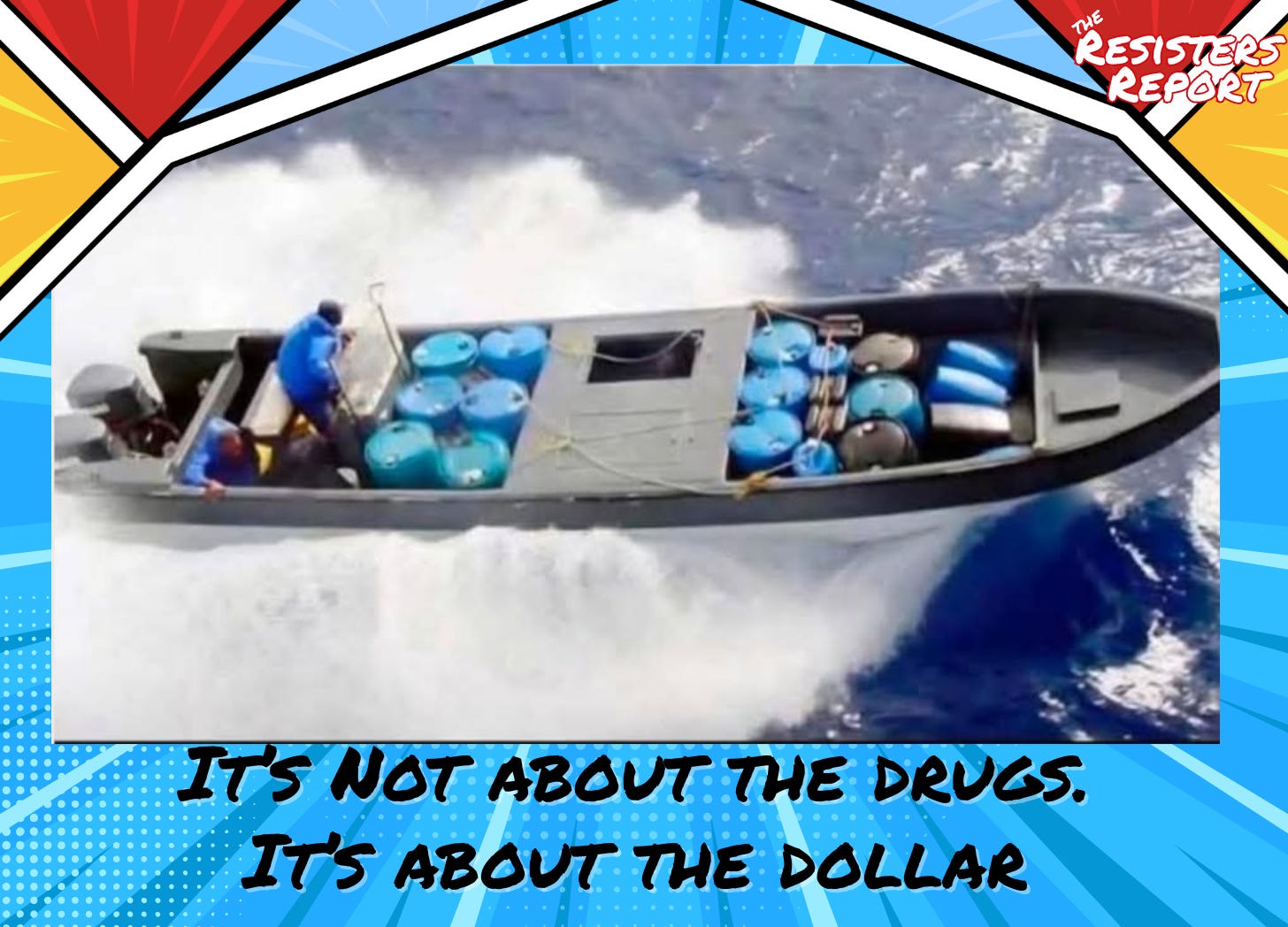
I spent a week at high elevation—which, if you know me, is not a good situation for my health. My writing dropped off at the same time that Trump and his crew acted even more than usual. I’ve got multiple stories to catch up on, so let’s start with an easy one—those boats they’re exploding? The ones with so-called drug dealers being murdered?
It’s all even more fake than they’re letting on.
There’s a clip Trump keeps waving around: a grainy black-and-white shot of a long skinny boat on dark water, then a flash, then nothing.
He says it’s “loaded up with mostly fentanyl.” He says those were “narco-terrorists” headed for the United States.
Except when people zoomed in on the still, what you could see weren’t neat little drug bricks in shrink-wrap. What you could see were big containers and jerry cans that look an awful lot like fuel. The kind of setup you’d expect on a coastal workboat with three thirsty outboards trying to hop between Venezuela and a nearby island.
You don’t fuel a run to Miami that way.
You fuel a run across the neighborhood.
And that’s the tell.
Because if this were really about fentanyl, the story would have to line up with geography, with known trafficking routes, with DEA’s own data.
It doesn’t.
So if it’s not about fentanyl, what the hell are we bombing?
And the big question—why? As usual, it’s about money. Except it’s not just money this time. Keep reading, because there’s a surprise ending on this one.
The fentanyl fairy tale doesn’t match the map
Let’s start with the basics.
These now-famous strikes have been hitting boats between Venezuela and its neighbors in the Caribbean and Pacific — Venezuela to Trinidad and Tobago, Colombia, islands along the coast. That’s a short-hop coastal corridor, not a direct line to Miami Beach.
Locals describe the traffic on those routes as:
Fishing boats
Fuel runners (moving gasoline between islands)
Small-time smugglers moving weed or coke into regional markets
People just trying to get from A to B in collapsing economies
Not exactly fentanyl super-tankers.
Meanwhile, U.S. agencies themselves say the fentanyl killing Americans is:
Manufactured mostly in China
Turned into pills and powders by cartels in Mexico
And smuggled over land at the U.S.–Mexico border, overwhelmingly in cars and trucks, not by fishing boats in the southern Caribbean
In fact, they barely mention Venezuela in fentanyl reports at all.
So we’ve got:
Boats in the wrong place
On the wrong routes
Carrying containers that look like fuel
In a region that’s not a documented source of U.S. fentanyl
…and the President is still screaming, “Fentanyl!”
When the evidence and the map disagree with the speech, you follow the evidence and the map.
Which means we have to ask the real question:
If it’s not a drug war, what kind of war is it?
The answer requires a little history lesson.
This goes back to 1971: when the dollar stopped being money and became a weapon
To understand why some poor bastard in a fishing skiff just got vaporized by a U.S. bomb, we have to go back to a completely different kind of explosion: the one that blew up the gold standard.
In 1971, Nixon took the dollar off gold. Up to that point, foreign governments could, at least in theory, march up and swap their dollars for U.S. gold at a fixed rate. When Nixon slammed that window shut, the dollar became pure fiat — valuable because we all agree to treat it as valuable.
That creates a problem: if the dollar isn’t backed by gold anymore, what keeps everyone using it?
Enter Henry Kissinger and the petrodollar.
In the mid-70s, the U.S. cut a deal with Saudi Arabia and, by extension, OPEC:
You price your oil in dollars.
You recycle those dollars into U.S. banks and Treasury bonds.
In exchange, you get U.S. weapons, protection, and a very cushy relationship.
That’s the quiet backbone of American power for the last 50 years:
The dollar isn’t backed by gold.
It’s backed by oil.
Not by owning the oil — by owning the unit you’re forced to use to buy it.
Once oil is priced in dollars, everybody who needs oil needs dollars. That means constant global demand for:
U.S. currency, and
U.S. debt (Treasury bonds)
And that, in turn, lets Washington:
Run huge deficits
Print like hell in every crisis
Weaponize access to dollars through sanctions
If you can’t get dollars, you can’t easily buy oil. If you can’t buy oil, your economy chokes.
And if there’s one thing Trump cares about, it’s the economy choking.
Every time someone steps outside the dollar, the U.S. reaches for a new excuse
Look at the pattern over the last few decades:
Iraq started selling oil in euros. Suddenly it’s not about currency anymore; it’s about WMDs and “spreading democracy.”
Libya floated a pan-African gold-backed currency idea. Overnight, Gaddafi goes from “weird dictator we can work with” to “must be removed for humanitarian reasons.”
Iran builds its own oil bourse and does non-dollar deals. Now it’s all about terrorism and nuclear hysteria.
Venezuela starts cozying up to China and Russia, talking about non-dollar pathways for its crude. We’re told the issue is socialism and “failed state” chaos.
The script changes — “dictators,” “terror,” “human rights,” “drugs” — but the underlying crime is always the same:
You tried to sell energy without using our money.
That’s the unforgivable sin.
Which brings us back to Venezuela’s coastline and the floating bodies this administration is pretending not to see.
Why Venezuela’s boats suddenly matter so much
On paper, Venezuela is a broken country. Hyperinflation. Sanctions. Political repression. A massive refugee crisis.
But under that wreckage, there’s one big, glowing number:
~300 billion barrels of proven oil reserves.
It’s the largest known pile of oil on Earth.
Even in ruins, that gives Venezuela something Washington cares about: leverage. And in the last few years, they’ve been using that leverage to sell more crude to China, work around U.S. sanctions and explore deals that don’t rely as much on U.S. banks and U.S. dollars
At the same time:
The U.S. is quietly parking warships and a carrier strike group in the Caribbean.
Analysts are openly talking about the possibility of a naval blockade that could strangle Venezuelan exports without a single official “we’re blockading” headline.
And then, like clockwork, we get this new “anti-drug” offensive: Fishing boats, fuel runners, ferries blown to hell under a fentanyl label that doesn’t match the route, the cargo, or the agencies’ own reporting.
You don’t need a tinfoil hat to connect those dots.
Bombing coastal traffic doesn’t stop a fentanyl pipeline that runs through Mexico.
What it does do is turn the waters around Venezuela into a zone of fear and instability, so that anyone thinking about buying their oil from Venezuela will decide it’s not worth the risk.
Make a one-time donation
☕I will happily let you support my work by buying me a $3 coffee or making a Venmo donation.☕
Sea power is the last pillar propping up a rotting empire
Here’s the thing. The U.S. doesn’t dominate manufacturing anymore. It doesn’t dominate diplomacy. And our own domestic politics are a dumpster fire in a hurricane.
What we still dominate is naval power — the ability to patrol, surveil, and, if we feel like it, shut down the world’s choke points. If Washington can’t fully control the price of oil anymore, it can still control the risk of moving oil.
For the people on those boats, none of this is abstract. Those men are not worried about global reserve currency status. They’re just hauling fish, moving fuel, and trying to make a little money in a tight economy.
They’re not villains. Not drug dealers. Just hard-working crews being used as scapegoats.
We’ve done this dance before in the War on Drugs, but this new campaign is even more naked. We’re not pretending to arrest anyone, or seize evidence, or even making false arrests.
We’re blowing up boats.
Say it plainly
The United States did not bomb those boats for fentanyl.
It’s not a drug war.
It’s a currency war with human wreckage floating in it.
It’s hard to imagine going lower than bombing innocent men clinging to refuse in the ocean. But yeah, they pulled it off. They went lower than low.
Take care,
—Rosie
🔥I’m a little bit behind. Was any of this new to you? Does anything surprise us anymore? Share your thoughts in the comments. 👇
Sources:
https://www.federalreservehistory.org/essays/gold-convertibility-ends
https://www.eia.gov/international/analysis/country/VEN
Want to help?
Sure, I’ll ask for a donation in a second (that’s the only way I can keep writing)—but shares are free and keep us growing. If this story mattered, pass it on.
Thanks for reading The Resisters' Report! Subscribe to receive new posts and support my work.
💪 Did this resonate with you?
If you've found strength or clarity in my work, and you're in a position to help, I’m asking for your support. I’m not a fan of paywalls, especially at a precarious economic time when so many of us are financially strapped. I don’t want anyone to be denied access to anything due to financial constraints. So I’m determined to keep my work free to all.
A one-time donation, however, can help cover my relocation expenses, medical care due to my multiple chronic illnesses caused by long COVID, and the continued reporting I do through the Resisters’ Report. Every dollar helps keep this voice—my voice—alive and writing. Even just a $3 coffee.
👉 Donate with Venmo, Paypal or Buy Me a Coffee
Let’s fight disinformation, denial, and disease—together.
If you’d like to manage the reports that land in your inbox, go here to opt out.
To answer your question, Rosie, at least for me this is new information and very illuminating. Thanks!
I figured oil was involved, but this historical explanation was very helpful, Rosie. May this rotting regime decay quickly!